You can start investing with a small amount of money. The starting balance is rarely the real obstacle. Choosing an option that fits your situation is the part that actually takes thought.
If it feels like you don’t have enough to invest yet, you are not alone. That belief is the most common reason people postpone their first investment, and it is also the easiest one to test against the actual conditions of each product. This guide covers which options are available from small amounts, how they work, and which one may make sense for you.
Compound growth does not need a large balance to work. It needs time. And time starts today.
How much do you need to start investing?
The short answer: less than you probably think. There is no universal minimum — it depends on the product and the provider.
Short-term government securities are among the lowest-risk entry points in most markets, though the minimum and the buying process depend on the provider you use. Bank deposits and certificates work similarly: you commit the money for a term and receive the agreed rate under the contract’s conditions.
Cryptocurrencies go lower still. You don’t need to buy a whole unit of Bitcoin or any other digital asset — you can buy fractions with small amounts. Digital platforms let you transact with whatever amount you have available, without high minimums.
Mutual funds and ETFs (exchange-traded funds, bought like a stock) have also lowered their barriers. Ten years ago, a diversified fund required a significant amount and an adviser in the middle. Today, on some platforms, the threshold is considerably lower.
The U.S. Securities and Exchange Commission explains how time horizon and risk tolerance shape these choices in its Introduction to Investing and asset allocation guide.
Options for investing with little money
| Option | Minimum amount | Risk | Liquidity |
|---|---|---|---|
| Short-term government securities | Depends on provider | Low to moderate | Depends on maturity and market |
| Bank deposits and certificates | Depends on institution | Low to moderate | Depends on terms |
| Cryptocurrencies | Variable* | High | High |
| Mutual funds | Depends on provider | Low to high | Depends on fund |
| ETFs / index funds | Depends on broker | Moderate | Generally high |
| Fractional shares | Variable* | Moderate to high | Generally high |
*The minimum is variable because it depends on the platform you choose and on the asset’s market price (some apps allow fractional purchases from very small amounts).
For the full picture organized by risk profile, see our guide on where to invest your money.
When the amount is very small
At this level, fractional crypto and low-minimum digital products are the most direct route, because they don’t impose a high entry threshold or require an adviser in the middle.
The trade-off is risk: crypto volatility is high, which means the value can rise or fall significantly in a short time. Before depositing on any platform, verify its current terms and its registration.
When you can commit to a term
This is where deposits, certificates and low-minimum funds come in. A certificate gives you an agreed rate in exchange for leaving the money untouched for a set term; if you need the capital before maturity, you may face a penalty or be unable to withdraw at all.
Index funds also appear here. An ETF is a fund that bundles dozens or hundreds of assets and trades on an exchange like a stock. Instead of picking a single company, you invest in an entire index — the S&P 500, for example, which tracks 500 of the largest companies in the United States.
For someone starting out who doesn’t want to analyze individual companies, index funds are one of the most efficient ways to invest, because they combine real diversification with low costs and no need for active decisions. If that path interests you, we have guides on how to choose an ETF and on the difference between stocks, ETFs and exchange-traded funds.
When you can diversify
With a little more capital, it becomes possible to spread across two or three different assets, which reduces exposure to any single instrument and improves your strategy from the start. The rule doesn’t change with the amount — the scale changes, not the principle.
How to start investing in crypto with little money
One of the most common myths about cryptocurrencies is that you need to buy a whole unit. That is not the case.
Cryptocurrencies are divisible. Bitcoin, for example, can be bought in fractions down to eight decimal places, which means you can invest a small amount and receive the fraction equivalent at the current price. You don’t need the full price of the coin to have exposure to its performance.
What you do need to be clear about before entering: crypto carries a high level of risk. Its value can drop 20% in a week and recover within a month — or not recover at all. That volatility is part of how digital asset markets work, and it’s the reason crypto is not recommended as your only investment, especially for someone starting with a small amount.
You can review the supported cryptocurrencies and, if you’re taking your first steps, read your first steps investing in crypto with Bitso and how to define your investment strategy.
How to invest in stocks with little money
Until a few years ago, buying individual shares of companies like Apple or Amazon required amounts that were out of reach for most people. Fractional shares changed that.
A fractional share is exactly what it sounds like: a fraction of the value of a whole share. If a stock trades at 180 USD and you want to invest less than that, you buy the corresponding portion and participate in that company’s performance in proportion to what you invested.
This means access to international markets no longer depends on the price of an individual share, but on how much you decide to invest. Fractional shares carry the same level of risk as whole shares — equity, with potential for gain and loss. The difference is the entry barrier, not the risk.
Important: Bitso does not provide stock access outside Mexico. The stock service accessed through the Bitso app with Nvierto by Bitso and Alpaca is available only in Mexico. Anyone researching stocks elsewhere should use an appropriately authorized local broker or adviser and verify its registration independently. If you want the background on how equities work before you start, see stocks for beginners.
How to make your first investment with Bitso
Opening an investment account used to mean branch appointments, printed forms and weeks of waiting. That is no longer how it works.
With a government-issued ID and your phone, you can have the app active and ready to use in minutes. You don’t need to talk to an adviser, you don’t need to visit a branch, and you don’t need a high minimum balance to begin.
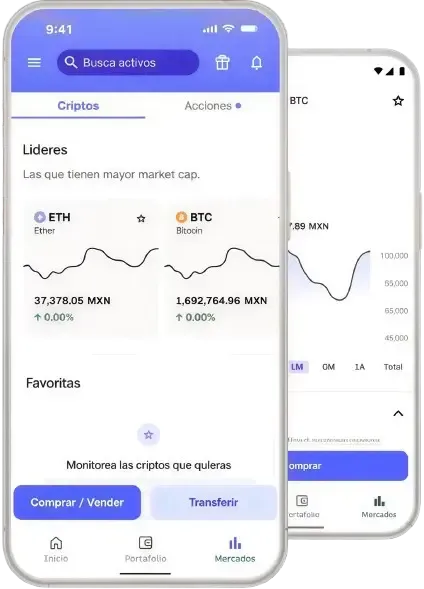
In the countries where Bitso operates, the app provides access to supported cryptocurrencies and local funding methods. Availability, deposit rails, fees and assets depend on your country and account, so confirm them in the app before you transact.
- 01
Open your account
Fully digital, with a government-issued ID. The process is guided step by step in the app and takes minutes.
- 02
Fund it
Use the deposit method available for your country. Check the required account holder and the applicable limits.
- 03
Make your first investment
From the app you can access the cryptocurrencies supported for your country, buying fractions from small amounts.
Explore the Bitso app and select your country to see current availability.
Mistakes beginners make when investing with little money
Mistake #1: Waiting until you have “enough” to start
This is the most expensive one, even though it doesn’t look like it. Every month the money sits in a non-yielding account, inflation erodes it quietly and without exception. The cost of not starting isn’t zero — it’s a sustained loss of purchasing power.
There is no threshold above which investing suddenly “becomes worth it.” What does exist is the difference between putting money to work now, even in small amounts, and waiting for a moment that rarely arrives.
Mistake #2: Putting everything into one option
When investing for the first time with a small amount, the temptation is to concentrate on whatever looks most attractive: the crypto that rose the most last month, or the fund someone recommended. The problem is that concentrating everything in a single instrument, whichever it is, adds risk unnecessarily.
Diversifying doesn’t require large sums. It’s possible to split between a low-risk deposit and crypto, or between an ETF and fractional shares. The rule doesn’t change with the amount — the scale changes, not the principle.
Mistake #3: Selling in the first month because the value dropped
Equity investments (stocks, ETFs, crypto) are volatile. That is part of how they work. The most frequent beginner mistake is reading a temporary decline as an exit signal, selling, and locking in the loss before the market recovers.
Your time horizon matters as much as the asset you choose. If you invest expecting a long-term result, short-term swings shouldn’t dictate your decisions. Before you enter, decide how long you can leave that money untouched — that is what gives you clarity when the market moves against you. Our guide on crypto investment strategies goes deeper on this.
Frequently asked questions about investing with little money
There is no universal minimum. It depends on the product and the provider. Some funds, brokers and cryptocurrency platforms support small amounts or fractional units; others require a minimum balance or a full share.
The most accessible options tend to be low-minimum products with clear terms: a short-term deposit, a conservative fund, or fractional crypto. Compare the net rate, the fees, the term and the withdrawal conditions before deciding, and verify the provider's registration.
Yes, through fractional shares offered by an authorized broker: you don't need the full price of a share to invest in a company. Note that Bitso does not provide stock access outside Mexico, so to invest in stocks elsewhere you should use an appropriately authorized local broker or adviser.
Yes. Cryptocurrencies are divisible: you can buy fractions from small amounts without needing a whole unit. What matters is understanding the level of risk before you enter, and confirming availability, limits and fees in the app.
The amount does not determine safety — the provider does. Verify which company provides each service, whether it holds the applicable authorizations, and under what conditions it operates. Confirm that information independently before depositing.
It depends on your risk profile. A deposit or short-term government security offers a more predictable return with lower risk to your capital. Crypto has higher potential upside with much higher volatility. A common approach for a beginner is to start with the lower-risk option and assign only a small portion — money that can stay untouched for a long time — to digital assets.
It depends on the instrument. A certificate or deposit has a maturity date and may not allow early withdrawal. Crypto generally has immediate liquidity. ETFs and mutual funds depend on the broker and its settlement policy. Always review liquidity conditions before choosing.
No. Stock access through the Bitso app with Nvierto by Bitso and Alpaca is exclusive to Mexico. Outside Mexico, Bitso should not be treated as a stock brokerage or advisory service.
The first step always looks like the hardest
Starting to invest with little money doesn’t require advanced knowledge or capital most people don’t have. It requires choosing an instrument that fits your profile, opening an account with a provider that holds the applicable authorizations, and making the first transaction.
Everything else — understanding markets better, diversifying further, adjusting your strategy — comes after. Financial education isn’t something you finish before you invest: you build it while investing.
This content is for informational and educational purposes only. It is not personalized investment advice. All investing involves risk, including the possible partial or total loss of capital. Past performance does not guarantee future results.