Where you invest depends on three things: how much risk you can tolerate, how long you can leave the money invested, and what you want it to accomplish. There is no single correct answer. The useful answer is the one that fits your finances and goals.
This guide compares common choices, from government securities and bank products to funds, ETFs, stocks, real estate, and cryptocurrencies. They are grouped by general risk level, not ranked from best to worst.
Every investment carries risk. Before you commit money, understand the product, its fees, its liquidity, and the conditions under which you could lose value.
What should you know before investing?
Start with three concepts. Together, they determine which products may be reasonable to research and which ones are unlikely to fit.
Risk tolerance. This is your ability and willingness to accept losses or price swings. A decline that feels manageable to one person may cause another to sell at the worst possible moment. Your honest reaction matters more than the label you would like to have.
Time horizon. When will you need the money? A goal that is months away usually calls for more liquidity and less volatility than a goal that is decades away. A longer horizon can give an investment more time to recover from market declines, but it never guarantees a positive return.
Liquidity. How quickly can you turn the investment into cash, and at what cost? Some assets trade every business day. Others impose a term, a penalty, or a long selling process.
The U.S. Securities and Exchange Commission explains how time horizon and risk tolerance influence asset allocation in its Introduction to Investing and asset allocation guide.
Common ways to invest your money
| Investment type | General risk level | Return potential | Liquidity | Starting amount |
|---|---|---|---|---|
| Government securities | Low to moderate | Low to moderate | Depends on maturity and market | Depends on provider |
| Bank deposits and certificates | Low to moderate | Low to moderate | Depends on terms | Depends on institution |
| Mutual funds | Low to high | Variable | Depends on fund | Depends on provider |
| ETFs | Moderate to high | Variable | Often high in liquid markets | Price of a share or fraction, where offered |
| Individual stocks | High | Variable | Often high in liquid markets | Depends on broker |
| Cryptocurrencies | High | Variable and volatile | Depends on asset and platform | Small amounts on some platforms |
| Real estate | Moderate to high | Variable | Low | Often high |
These are broad categories, not risk ratings for a specific product. Returns are not guaranteed, and fees, taxes, liquidity, and investor protections vary by jurisdiction and provider.
Lower relative risk: government securities and bank products
Government securities are debt issued by a national government. Their risk, return, tax treatment, and trading rules depend on the issuer and the security. Holding a bond to maturity is different from selling it early: market interest rates can affect its price before maturity.
Bank savings products and certificates of deposit may pay an agreed or variable rate. Their liquidity can range from immediate access to a fixed term with an early-withdrawal penalty. Deposit insurance, when available, applies only under the rules and limits of the relevant jurisdiction.
These products may fit short-term goals or the lower-volatility portion of a portfolio, but “fixed income” does not mean “risk-free.” Inflation, issuer credit, reinvestment, and liquidity can all affect the result.
Moderate or high risk: funds, ETFs, and stocks
Mutual funds pool money from many investors and hold a portfolio of assets. A fund can focus on bonds, stocks, money-market instruments, or a mix. The label alone does not determine its risk. Read the investment objective, holdings, fees, and redemption rules.
ETFs also hold a portfolio and trade on an exchange. Some track broad indexes; others focus on one industry, country, commodity, or strategy. A broad fund can make diversification easier, but an ETF is not automatically diversified. The SEC notes that narrowly focused funds may still leave an investor concentrated in one segment of the market.
Individual stocks represent ownership in a company. Their prices can respond to business performance, interest rates, economic conditions, and investor expectations. A single stock creates more company-specific risk than a broad portfolio.
You can review official overviews of investment products and mutual funds and ETFs before comparing providers.
Higher volatility: cryptocurrencies and digital assets
Cryptocurrencies can move sharply in short periods. Risks may include price volatility, limited liquidity, operational failures, fraud, cybersecurity incidents, and changes in regulation. Investor protections also differ from those that may apply to bank deposits or registered securities.
Cryptocurrencies may be unsuitable as a person’s only investment. Someone who chooses to hold them should size the position according to the possibility of a substantial or complete loss. The SEC’s investor resources emphasize the significant risks associated with cryptocurrency investments.
How do you choose based on your profile?
Ask one practical question first: How long can I leave this money untouched? Then combine the answer with your ability to tolerate losses.
Conservative profile. If the money supports a near-term goal or you place a high value on limiting price swings, research liquid bank products, short-term government securities, or conservative funds. Compare inflation, fees, credit risk, and withdrawal conditions.
Moderate profile. If your horizon is several years and you can tolerate fluctuations, diversified bond and stock funds or broad ETFs may be worth researching. Their value can still fall, sometimes for extended periods.
Higher-risk profile. If you have a long horizon and the financial capacity to absorb losses, individual stocks, sector funds, and cryptocurrencies may occupy part of the portfolio. Higher potential return is not a promise of better results.
Many portfolios combine categories. The mix should reflect your goals, emergency needs, debts, tax situation, and capacity for loss—not a generic model or a recent market winner.
What can you do through Bitso?
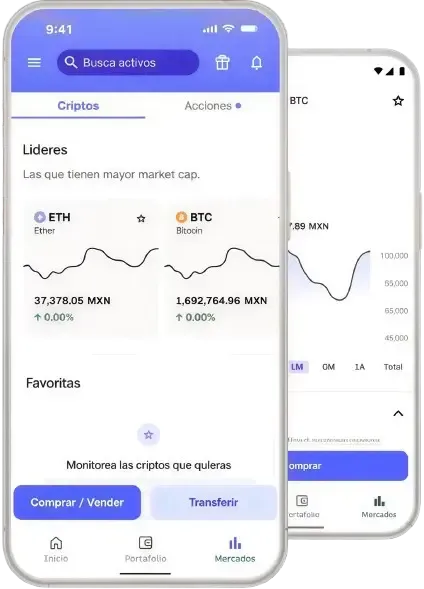
In countries where Bitso operates, the app provides access to supported cryptocurrencies and local funding methods. Availability, deposit rails, fees, and assets depend on the user’s country and account.
Bitso does not provide stock access outside Mexico. The stock service accessed through the Bitso app with Nvierto and Alpaca is available only in Mexico. Anyone researching stocks elsewhere should use an appropriately authorized local broker or adviser and verify its registration independently.
Before using any product in the app:
- check whether it is available in your country;
- identify the entity providing the service;
- review fees, risks, liquidity, and custody terms;
- start with an amount that fits your financial situation.
Explore the Bitso app and select your country to see current availability.
Common mistakes when choosing an investment
Mistake 1: chasing the highest recent return
The investment that rose the most last year may not repeat that result. A higher potential return usually comes with a greater chance of loss. Focus on what could drive both gains and declines.
Mistake 2: investing money you may need soon
If you need the money during a market decline or before a product matures, you may be forced to sell at a loss or pay a penalty. Keep upcoming expenses and emergency reserves separate from long-term investments.
Mistake 3: concentrating everything in one asset
Owning one company, one cryptocurrency, or one narrowly focused fund exposes you to a single source of risk. Diversification cannot prevent losses, but it can reduce dependence on one issuer or market segment.
Investing is a process
Investing is not a one-day decision. It is a process of setting goals, comparing products, monitoring costs, and adjusting as your life changes.
You do not need a perfect market entry point. You do need to understand what you own and why it belongs in your plan. If you need a recommendation for your personal circumstances, consult an appropriately authorized professional.
Frequently asked questions
How much money do I need to start investing?
There is no universal minimum. It depends on the product and provider. Some funds, brokers, and cryptocurrency platforms support small amounts or fractional units; others require a minimum balance or full share.
What is the safest investment?
No investment is risk-free. Short-term government securities and insured bank deposits are often used for lower-risk goals, but they still have conditions, limits, inflation risk, and jurisdiction-specific protections.
Are bonds better than cryptocurrencies?
They serve different purposes and have very different risk profiles. A bond is a debt instrument with defined terms; cryptocurrencies can be highly volatile and may lack protections associated with regulated securities or insured deposits.
Can I lose all my money?
Yes, depending on the investment. Concentrated stocks, speculative securities, and cryptocurrencies can lose most or all of their value. Even lower-risk products can be affected by inflation, liquidity, or issuer default.
How do I identify my risk profile?
Consider when you need the money, how much loss you can financially absorb, and how you are likely to react to a decline. Then compare each product’s risks, fees, and liquidity with those constraints.
Does Bitso offer stocks in every country?
No. Stock access through the Bitso app with Nvierto and Alpaca is exclusive to Mexico. Outside Mexico, Bitso should not be treated as a stock brokerage or advisory service.
The information provided is for informational purposes only and does not constitute financial advice. Please note that past performance does not guarantee future results.