Summary
- Types of investments are organized by asset: fixed income, equities, funds, U.S. and international stocks and ETFs, cryptocurrencies, real estate, and your own business.
- Each category comes with a different level of risk and liquidity, and higher risk does not automatically guarantee a better result.
- Investment funds let you diversify without picking each asset, while real estate and your own business usually require more capital and offer less liquidity.
- Choosing what to invest in means matching these categories with your risk profile, your investment horizon, and your financial goals.
Many people want to invest but don’t know where to start, or which instruments exist beyond a traditional savings account. Meanwhile, inflation erodes the value of money that sits without earning a return.
This guide explains what you can invest money in, by asset type, so you can choose based on your financial goals and your risk profile.
What types of investments are there by asset?
The types of investments you can use to decide how to invest your money are organized by asset, not by amount or platform: fixed income, equities, funds, U.S. and international stocks and ETFs, cryptocurrencies, real estate, and your own business. Investing means putting capital into one of these instruments in the expectation of a return, while accepting some risk.
Each category comes with a different level of risk and liquidity. Before choosing, it helps to understand which investment instrument fits your financial goals and your investment horizon, without assuming that higher risk automatically guarantees a better result.
1. Fixed income: government securities, bonds, and other debt instruments
Fixed income brings together debt instruments: you lend money to a government or a company in exchange for periodic payments or a payment at maturity. Short-term government securities, such as U.S. Treasury bills, are issued by national governments. There are also longer-term government bonds, inflation-linked bonds in some countries, and corporate bonds.
Other debt instruments include bank certificates of deposit and other fixed-term deposits, where you agree to a fixed interest rate for a set period. They are often seen as relatively conservative compared with other categories, although no instrument is risk-free. They can be useful for diversifying the more stable part of your portfolio.
2. Equities: what stocks are and how they work
Stocks represent a proportional share of ownership in a publicly traded company. Their value rises or falls depending on the company’s performance and market conditions, which is why they are part of equities. You can gain from price appreciation or, in some cases, from dividends, although not all stocks pay them.
This type of investment means accepting more volatility in exchange for greater long-term growth potential. It is not ideal for money you might need soon, since the value can drop in the short term. There are stocks listed on your local exchange and stocks of U.S. or other international companies, which open up a broader market.
3. Investment funds: diversify without picking one by one
An investment fund pools money from many investors and spreads it across different assets, such as stocks, bonds, or both, managed by professionals. Its main benefits are diversification and professional management, without having to choose each instrument individually.
Funds come in different types: bond funds, stock funds, balanced funds, and ETFs, which trade on an exchange like a stock. They charge management fees, and their return depends on the performance of the assets they hold, not on a fixed rate.
They can be useful for people looking for diversified exposure without analyzing each instrument separately, or for beginners who prefer to leave asset selection to a professional team. With a long investment horizon, compound interest can favor those who consistently reinvest their returns.
4. U.S. and international stocks and ETFs
Today it is possible to access the U.S. stock market, with thousands of stocks and ETFs available, through digital platforms. It no longer depends on a traditional broker or large amounts, thanks to fractional trading, which lets you buy part of a share instead of a whole one.
These instruments tend to appeal to people who already want equity exposure and want to diversify geographically beyond their local market. As with any stock, the value of these assets can rise or fall, and there is no guaranteed return over any time frame. This section describes the general landscape of the stock and ETF market, without referring to a specific Bitso product: Bitso does not provide stock access outside Mexico, so anyone researching stocks elsewhere should use an appropriately authorized broker and verify its registration independently.
5. Cryptocurrencies: what they are and what risk they involve
Cryptocurrencies are digital assets that exist and are transferred using blockchain technology, without the backing of a central bank. Their value can rise or fall sharply in short periods, and there is no guarantee that the price will increase over time.
This type of asset makes sense for people who understand its volatility and want to allocate a portion of their portfolio to it, not all of it. It should not be mixed up with decisions about stocks, since they are services from different entities, each with its own risk logic.
If this is your first time with this type of asset, take the time to understand how it works before buying, review market volatility, and allocate only part of your available money: that is the foundation for your first steps investing in crypto.
6. Real estate: buying or renting out property to generate income
Buying a property to earn monthly rental income or to seek appreciation is one of the most traditional ways to invest money. There are also instruments that give you real estate exposure without buying an entire property, such as real estate investment trusts (REITs), a middle ground between the two extremes.
This category usually requires more starting capital and offers less liquidity than other instruments, since selling a property takes time. It is an alternative for people who want to diversify into a physical asset with a long investment horizon.
7. Your own business: investing in your own project
Investing in your own business means using your own capital to start or grow a project, from a small venture to a franchise. The return depends directly on how the business performs, which means more concentrated risk than other categories in this guide.
This option tends to suit people with experience in a specific industry who prefer an active role in their investment, not just a passive one. It requires time and dedication, as well as capital.
Each of these categories serves different goals, which intersect with how to choose where to invest based on your risk profile and your own financial situation.
How to choose what to invest in based on your risk profile
Choosing where to invest your money depends on matching the categories in this guide with your risk profile and your financial goals. Before deciding, ask yourself a few guiding questions: How long can you leave the money invested? How comfortable are you if the value drops temporarily? Your answers reflect your risk tolerance.
| Category | Relative risk | Liquidity |
|---|---|---|
| Fixed income (government securities, bonds, CDs) | Low to moderate | High to moderate |
| Bond funds | Low to moderate | High |
| Balanced or stock funds | Moderate to high | Moderate |
| Stocks (local and international) | High | High |
| Cryptocurrencies | High | High |
| Real estate | Moderate to high | Low |
| Your own business | High | Low |
Fixed-income instruments and bond funds are usually associated with more conservative profiles. Stocks, including U.S. and international stocks and ETFs, along with cryptocurrencies and your own business, are usually associated with greater tolerance for volatility.
No combination of instruments guarantees results, and diversification does not eliminate risk entirely. Understanding each category well, rather than chasing the option that promises the highest return, is what helps you build an investment strategy that fits your personal finances.
Several of these options, in the Bitso app
You’ve seen that money can go into different types of assets, each with its own logic and level of risk. Before choosing, it is worth understanding what each instrument is and which profile it makes sense for, rather than looking for the option that promises the highest return.
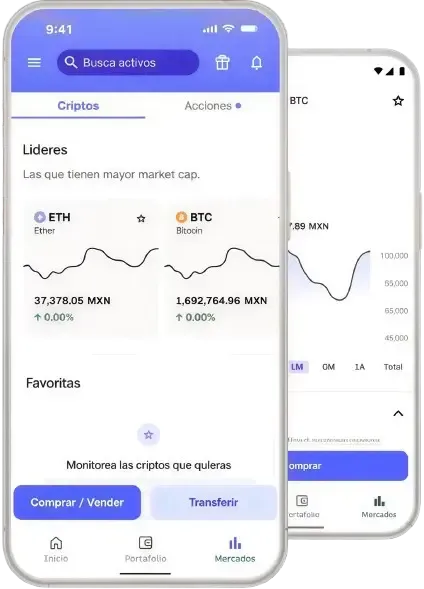
In countries where Bitso operates, the app brings one of these categories into a single place: you can buy and hold supported cryptocurrencies. Availability, fees, and assets depend on your country and account. Find out which categories in this guide you can start exploring with the Bitso app.
The information provided is for informational purposes only and does not constitute financial or legal advice.
Frequently asked questions
Saving means setting money aside without necessarily trying to earn an additional return, prioritizing immediate access. Investing means putting that money into a financial instrument in the expectation of a return, while accepting some level of risk. Saving and investing usually go together: it helps to have a cushion available for emergencies before putting money into instruments with more volatility or less liquidity.
Not necessarily. Many financial instruments let you start with accessible amounts, although the exact minimum varies by platform and asset type. Some government securities programs, certain investment funds, and fractional trading of stocks and ETFs tend to have low entry points compared with buying an entire property or starting a business. Before investing, confirm the current minimum with each financial institution or platform you are considering.
Fixed-income instruments, such as short-term government securities and other government debt, are often seen as relatively conservative compared with the other categories in this guide. That does not mean they are risk-free, but their behavior tends to be more stable than that of stocks or cryptocurrencies. The final choice depends on your risk profile, your investment horizon, and your financial goals, not just a general label.
It depends on each platform, the instrument it offers, and the country where it operates. Financial regulators supervise different services; in the United States, for example, the SEC and FINRA oversee securities markets and brokerage firms. Before using a financial institution or opening an investment account, verify how it is registered and which authority supervises that particular service. The SEC's Introduction to Investing offers free investor education to help you make informed decisions.
The right time frame depends on the instrument and your financial goals. Money set aside for short-term goals usually benefits from more liquid instruments, while a longer investment horizon lets you take on more volatile instruments, such as stocks or your own business. There is no single time frame that works for every investor profile, so it helps to define it based on your own financial situation.
Yes, combining categories is common among people who want to diversify across different investment alternatives. For example, someone might put part of their money into fixed income, another part into investment funds, and another into cryptocurrencies, depending on their risk profile and financial goals. Diversifying does not eliminate risk entirely, but it can help spread it across financial instruments that behave differently in the market.