Summary
- Choosing a way to invest goes beyond the instrument: it also includes your risk profile, your time frame, the channel you use, and how involved you want to be.
- Conservative, moderate, and aggressive profiles reflect how much variability you are willing to tolerate, not a promise of how much you will earn.
- Your time frame determines how much volatility your money can handle: the short term prioritizes liquidity, while the long term can absorb more temporary swings.
- A digital channel changes how you access an investment product, but safety depends on how each platform is regulated.
Choosing how to invest money often feels like picking between stocks, cryptocurrencies, or real estate, and that view narrows your options and creates doubt. But the way you invest, meaning your risk profile, your time frame, and the channel you use, matters as much as the instrument. Here we explore those approaches to help you find the one that fits you.
What does choosing a way to invest mean, beyond the product?
Choosing a way to invest means deciding the criteria you use to get to an instrument, not just which instrument you pick. When you think about where to invest money, you probably think first of stocks, cryptocurrencies, investment funds, or real estate. But your risk profile, your time frame, your channel, and your level of involvement shape how you get to those instruments.
These variables are not mutually exclusive: if you want to grow your money over time, it is common to combine them in different ways at once. For example, someone might be:
- Conservative in their risk profile, but digital in the channel they use to invest.
- Aggressive in their profile, but advised, because they are just starting to explore the topic.
That is why it helps to start with plain language: talking about your savings and everyday decisions, not technical portfolio jargon, and leaving behind the common myths about investing that often hold people back from the first step.
Ways to invest based on your risk profile
Your risk profile is how you decide how much variability in results you are willing to tolerate, not a promise of how much you will earn. It is also known as your investor profile, and it is usually divided into three levels: conservative, moderate, and aggressive. None is better than the others; it depends on your risk tolerance.
| Profile | Tolerance for loss | Example of an associated instrument |
|---|---|---|
| Conservative | Low: prioritizes preserving the value of the money | Short-term government securities, certificates of deposit, or savings accounts |
| Moderate | Medium: accepts some variability in exchange for more movement | A mix of fixed income and equities, such as mutual funds or index funds |
| Aggressive | High: tolerates greater variability in pursuit of other results | Stocks, ETFs, or cryptocurrencies |
Short-term government securities, such as U.S. Treasury bills, are issued by national governments and, in some countries, can be bought directly through an official platform, along with longer-term government bonds. They are examples of fixed income, designed for people who want less price movement. Diversifying across several instruments also helps moderate overall variability.
At the other end, an aggressive profile might include U.S. and international stocks and ETFs or cryptocurrencies, assets with higher volatility; some stocks also pay dividends. Higher risk does not mean a guaranteed higher return: it means greater variability in results, with no guarantee of better performance.
Your risk profile is not a fixed label: it can change with your stage of life or your financial goals. Someone conservative today may become moderate later on, and vice versa.
Ways to invest based on the time frame you have in mind
The time frame you have in mind also determines how much volatility your money can tolerate.
| Horizon | Example goal | Main consideration |
|---|---|---|
| Short term (months) | A trip or an emergency fund | Prioritizes liquidity, being able to access the money soon |
| Medium term (1 to 3 years) | A down payment on a car | Can tolerate somewhat more movement |
| Long term (more than 3 years) | Retirement | Can be exposed to more temporary volatility |
Each horizon tolerates a different amount of movement before you need the money back, and each connects with different financial goals, such as a trip, a car down payment, or retirement. The short term prioritizes having the money available soon.
To choose well, think about your financial goals and your liquidity: how much you need available and by when. This criterion connects with how to choose where to invest based on your risk profile, because time frame and profile usually go hand in hand.
Your time frame doesn’t need to match a single instrument: what matters is that the goal and the time available are aligned, without assuming the money will always recover in time. Leaving money uninvested can also lose value to inflation.
Ways to invest based on the channel: digital or traditional banking
The channel you use to invest, digital or traditional banking, changes how you access an investment product, not how valid it is.
Traditional banking may require in-person paperwork and branch hours, regardless of the type of investment you are looking for. Digital platforms, on the other hand, let you open an investment account from your phone, without depending on a physical office.
Some practical advantages of investing through a digital channel:
- Account opening in minutes, without in-person paperwork.
- Full management from your phone, at any time.
- In the case of cryptocurrencies, 24/7 trading, without depending on traditional stock market hours.
- No need to visit a branch.
Being digital doesn’t mean operating without regulation. Many digital platforms operate under formal regulatory frameworks, and which authority supervises them depends on the country and the service they provide.
The range of options is broad: traditional banks, brokerage firms, online investment apps, and other digital options. Each one involves a different investment product, with its own account-opening process, its own costs, and its own supervisory framework.
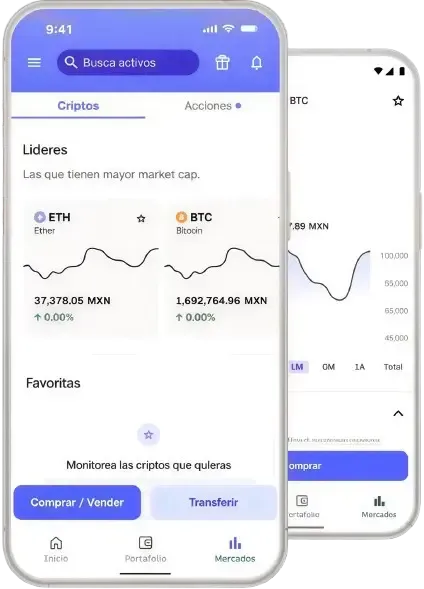
Among digital options, Bitso is one of the platforms available, in the countries where it operates, for managing cryptocurrencies from your phone. Cryptocurrency prices are highly volatile, so it helps to understand that movement before you buy.
Ways to invest based on your level of involvement
Your level of involvement defines how much you decide and execute yourself, compared with how much you delegate to professional support. There are two main approaches: self-directed, where you make every decision, and advised, with guidance or support within a platform.
Self-directed
You decide what to buy and when, with no intermediaries in the decision. It tends to suit people who already have experience or want full control over their financial instruments.
Advised
Someone else takes part in your decisions, whether through professional support or guidance within the platform itself. It tends to help people who are just starting out and prefer more direction before deciding.
Self-directed doesn’t mean without help: many digital platforms offer financial education and supporting content within the app itself. Neither approach is automatically better; it depends on each person’s context.
How to choose the way to invest that suits you best
Choosing the way to invest that suits you best means combining these four variables, not copying someone else’s investment strategies. Thinking consciously about how to invest your money is a good starting point. These questions help you find your own combination:
- How much variability am I willing to tolerate in my results?
- When will I need this money?
- Do I prefer a digital channel or a more traditional one?
- Do I want to decide everything myself, or would I prefer support?
Combining your answers gives you a mix you can start with, without pressure to do everything at once, whether that mix includes stocks through an authorized broker or a different instrument; the goal is to move forward at your own pace, with support when you need it.
Bitso, a digital way to invest
Bitso is designed for people who prefer to decide how to invest without depending on a branch or lengthy paperwork: everything from an app, with the ability, in the countries where it operates, to move between supported cryptocurrencies, including stablecoins such as USDC where available. It is a digital, self-directed way to invest, designed for people who want control over their decisions.
Whatever combination of profile, time frame, and channel you choose, the first step is usually the same: having a reliable place to start from.
Discover what your money can do with the Bitso app.
The information provided is for informational purposes only and does not constitute financial or legal advice.
Frequently asked questions
Saving means setting money aside without trying to make it grow, prioritizing immediate access, for example in savings accounts. Investing means putting that money into an instrument in the expectation of a different result over time, while accepting some degree of risk based on your profile. The SEC's Introduction to Investing explains how to think about risk before deciding. Both decisions depend on your financial goals and how much liquidity you need.
Safety depends on regulation, not on the channel itself. Both traditional banks and regulated digital platforms can operate under the supervision of financial authorities; in the United States, for example, the Securities and Exchange Commission oversees securities markets. Before deciding, confirm that the platform is regulated in your country and understand what that supervision covers. An app's ease of use does not eliminate the risk of the instrument you choose.
Yes, in fact that is the most common approach. You can have a moderate profile, with part of your money in the short term and another part in the long term, using both a digital channel and occasional advice when you need it. Ways of investing are not closed boxes: they combine according to your financial goals, your risk tolerance, and your stage of life.
How often depends on your time frame and your level of involvement; there is no single rule for everyone. If you invest for the short term or in a self-directed way, reviewing more often can help you stay on top of things. If your horizon is long term, very frequent reviews can lead to rushed decisions; a periodic review, for example every quarter, is usually enough for most people.
It depends on the instrument and its liquidity. Some products let you withdraw at any time, while others have terms or conditions that may involve a penalty or a loss of value if you exit early. That is why it helps to review liquidity conditions before investing, especially if there is a chance you will need that money sooner than originally planned.
Not always. You can start in a self-directed way if you feel comfortable making your own decisions, relying on the financial education available within many digital platforms. If you prefer support, you can also choose an advised approach. The decision depends on your previous experience, the level of involvement you want, and how comfortable you feel choosing your own investment instruments. Neither option is wrong: what matters is choosing the one that fits your goals and the time you have available.