Summary
- How long you let your money grow often has a bigger effect on the final result than the amount you start with.
- Compound interest means the returns you have already earned can generate returns too, as long as you reinvest them instead of withdrawing them.
- Money can grow through interest, through yield on certain cryptocurrencies where offered, or through capital gains, and none of these mechanisms guarantees results.
- Choosing where to invest depends on your time horizon, your tolerance for volatility, and whether you want periodic payments or a gain when you sell.
Many people keep their savings somewhere that pays little or nothing, and over time that money quietly loses purchasing power to inflation.
There is no single right answer to the question of what to invest in to multiply your money. This article explains the mechanisms that exist and how to choose between them.
Why does time multiply your money more than the starting amount?
How long you let your money grow tends to matter more for the final result than how much you start with. When a return goes on to generate more returns, growth speeds up with each period. That is why starting earlier often matters more than starting with more money.
A hypothetical example:
Unrelated to any real product: if an amount doubled every certain number of years, a modest sum invested for a long time could end up ahead of a larger sum invested for a short time. Time makes the difference, not the starting point.
What is compound interest and why does it matter?
Compound interest is the mechanism by which the returns you have already earned also start generating returns, not just your original capital.
Simple interest vs. compound interest
- Simple interest: calculated only on the original capital.
- Compound interest: calculated on the capital plus the returns already earned.
That is why the effect of compound interest becomes more noticeable over time. Leaving your gains reinvested, instead of withdrawing them, is what activates this effect: if you take the returns out, your money keeps growing from the same starting point.
Saving vs. investing: what grows your money more
Saving and investing are not the same thing, even though people often mix them up. Saving means setting money aside without earning a return, and it loses purchasing power because prices rise while the amount stays the same. Investing aims for a return that can offset that loss.
Central banks such as the U.S. Federal Reserve track inflation closely because rising prices reduce what the same amount of money can buy. That is the risk of saving without investing: gradually losing purchasing power. Investing does not eliminate risk; it only changes its nature.
Risk and return: the relationship you need to understand
There is a general relationship between risk and potential return, although it is not an absolute rule. Instruments that can grow faster tend to come with more volatility, while more stable ones tend to grow more slowly. It is a tendency, not a guarantee.
A low-risk instrument, such as a fixed-income product or an interest-bearing account, tends to grow predictably but slowly. Stocks or cryptocurrencies may grow faster in certain periods, but they can also lose value, so it helps to understand how to evaluate a cryptocurrency before putting money into one. There is no guarantee that any asset will rise in price.
Interest, yield, and capital gains: ways money can grow
Your money can grow through three mechanisms. The first is interest, fixed or variable: your capital generates a periodic payment, as with fixed-income instruments or interest-bearing accounts, without depending on selling anything.
The second is yield on assets: on platforms that offer it, capital held in certain cryptocurrencies may generate a variable periodic payment, with a rate that changes depending on the asset and market conditions. Availability and terms depend on the platform and your country.
The third is capital gains: an asset, such as a stock, an ETF, or real estate, rises in value over time, and the gain is realized when you sell it.
It depends on the performance of the asset and the market, not on a fixed payment.
| Mechanism | How it works | Type of payment |
|---|---|---|
| Interest | Fixed income or interest-bearing account | Periodic |
| Yield on crypto | Certain cryptocurrencies, where offered | Periodic, variable |
| Capital gains | The asset rises in value | When you sell |
No mechanism guarantees results, and combining all three does not promise faster growth. What it does is diversify the type of risk you take on.
How long does it take for your money to multiply?
How long it takes for your money to multiply depends on the mechanism you choose and how consistent you are with your contributions. A single initial contribution is not the same as adding money regularly.
This is where your investment horizon comes in: the time you can leave your money growing before you need it, whether short, medium, or long term. The longer it is, the more room there is for the compounding effect to work, the same factor that matters when choosing where to invest based on your risk profile.
An important clarification:
A purely hypothetical example, such as something doubling every certain number of years, is not a promise of what will happen to your money but a way to understand the effect of time. The actual result depends on the mechanism, the amount, and your consistency.
How to choose based on your risk and time horizon
Choosing where to try to grow your money comes down to three simple questions:
- When will I need this money?
- Can I watch the value drop temporarily without panic selling?
- Am I looking for a periodic payment or a gain when I sell?
No instrument is automatically better for everyone: the answer changes with your situation and how long you are willing to wait.
Your answers give you a guide, not a fixed formula. Someone with a short horizon and low tolerance for volatility will probably prioritize predictable instruments; someone with more time may consider different options. The U.S. Securities and Exchange Commission offers free investor education in its Introduction to Investing if you want to go deeper, and many countries’ financial regulators publish similar resources.
Mistakes that slow your money’s growth
These are some common mistakes that slow your money’s growth even after you have decided to invest:
- Leaving money without any return for years, out of indecision or lack of information.
- Not reinvesting gains, which weakens the compounding effect.
- Ignoring the effect of inflation on money that earns nothing.
- Making decisions based on past results or on promises of guaranteed gains.
Avoiding these mistakes does not depend on finding the perfect instrument, but on keeping the habit of reviewing your decisions.
Bitso, the next step to grow your money
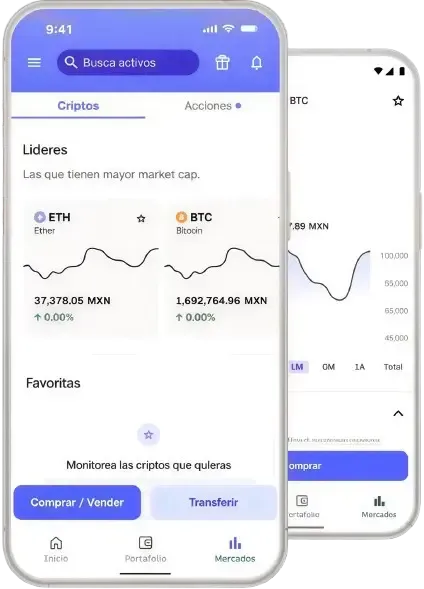
Understanding what makes your money grow is the first step. The next is choosing where that growth can happen clearly and without surprises. In countries where Bitso operates, the Bitso app lets you buy and hold supported cryptocurrencies while you decide your next moves. Availability, fees, and assets depend on your country and account.
You now know what makes money grow. Discover what yours can do with the Bitso app.
The information provided is for informational purposes only and does not constitute financial or legal advice.
Frequently asked questions
No. Every financial instrument carries some type of risk, even the most conservative ones. Leaving money uninvested is also a risk, because it loses purchasing power to inflation. Low-risk instruments, such as fixed income, offer more stability, but they do not eliminate risk. What changes from one instrument to another is the level of risk you take on, not whether there is risk at all.
There is no single amount that applies to everyone, because it depends on the instrument and the platform you choose. Many digital platforms let you start with small amounts, including fractional shares or cryptocurrencies. What matters most is not how much you put in at the beginning, but how consistently you contribute and how long you let that money keep generating returns.
Inflation reduces the purchasing power of your money over time, even if the number in your account stays the same. If your money earns no return, in practice you can buy less with the same amount later on. The real growth of your money depends not only on how much you have, but on whether it grows faster than inflation.
Earning a yield means your capital produces a periodic payment, as with fixed-income instruments or certain cryptocurrencies on platforms that pay periodic yield. Earning capital gains means an asset, such as a stock or a property, rises in value over time, and that gain becomes real when you sell it. One mechanism pays while you hold the asset; the other depends on selling it.
Reinvesting your gains tends to accelerate the compounding effect, because each new period of growth starts from a larger base than the last. Withdrawing your gains is not wrong, but it interrupts that effect and means your money keeps growing from the same starting point. The decision depends on whether you need that money soon or would rather let it keep growing.
In most cases, yes. Gains from investing, whether from yield or capital gains, are often subject to tax. The specific rules depend on the country where you are a tax resident, the type of instrument, and your personal tax situation, so check your tax authority's official guidance (in the United States, the IRS) or consult a tax professional before reporting your investment gains.