Making your money work for you takes more than picking a single stock or buying crypto assets at random; it is about building a solid strategy that fits your personal goals and the level of risk you are willing to take.
In this post you will find out why diversifying your capital is essential, which financial assets exist and some suggestions for building a balanced portfolio from Mexico.
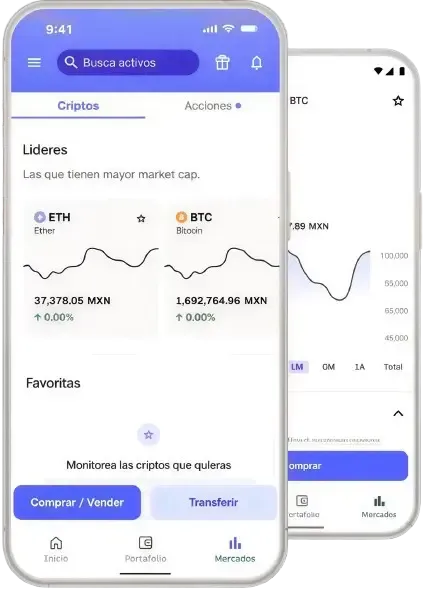
From the Bitso app you can sign up for different services that let you manage different types of assets, such as buying and selling crypto assets through The Badger Technology Company Limited, as well as accessing stocks and ETFs through Nvierto by Bitso*.
What is an investment portfolio?
An investment portfolio is the set of financial instruments a person holds in order to grow their capital, generate income or preserve the capital they already have. It can include stocks, bonds, ETFs, mutual funds, cryptocurrencies or a combination of several.
The reason the concept of a portfolio exists, rather than simply “an investment”, is diversification: spreading your capital across different types of assets reduces the risk that a single misstep affects all of your money. It is the same logic as not putting all your eggs in one basket, applied to your finances.
An investment portfolio can combine instruments as different as CETES (Mexican government bonds), stocks, ETFs or cryptocurrencies. The right mix depends on your investor profile, not on a single formula that works for everyone.
Why do you need an investment portfolio? The effect of inflation
Money that is not invested loses purchasing power over time. That is the effect of inflation: if the cost of living rises 5% in a year and your savings sit idle in cash, that same money will buy less than before.
The effect compounds. With annual inflation of 5%, an amount kept without investing can lose a significant part of its real value over ten years, even though the number of pesos in the account has not changed. Investing in an informed way is not speculating: it is a way to protect your capital from that erosion and, over time, make it grow under different market conditions.
No instrument guarantees beating inflation every year. What a well-built portfolio can do is give you a reasonable chance that your money earns more than inflation takes away, something cash kept idle cannot offer by definition.
Types of financial assets a portfolio can include
Not all investment instruments behave the same way. Before choosing which ones to use, it helps to understand which types of assets exist and what role each one plays within an investment portfolio.
| Asset type | What it is | Risk level | Liquidity | Who it is for |
|---|---|---|---|---|
| Fixed income (bonds, CETES, government bonds) | Debt securities that offer a predefined return in exchange for lending money to a government or company. | Low | Varies by instrument | Conservative profiles, or as an anchor of stability in moderate profiles |
| Equities (stocks and ETFs) | Ownership in a company (stocks) or funds that track a whole index (ETFs). | Medium to high | High for liquid instruments | Long investment horizons, moderate or aggressive profiles |
| Mutual funds | Instruments that pool the capital of several people to invest it collectively in a diversified portfolio run by a professional manager. | Varies by fund | Varies by fund | People who prefer to delegate the selection of instruments |
| Cryptocurrencies | Digital assets with high volatility and growth potential, different in nature from traditional stocks or bonds. | High | High | People with the risk tolerance to handle their volatility |
| Alternative assets (real estate, commodities, private equity) | Instruments outside the traditional stock market: real estate (low liquidity, generates rent), commodities (accessible through commodity ETFs) and private equity (investment in unlisted companies). | Varies, generally medium to high | Low | Profiles with more capital and long horizons |
No asset class is superior to another by definition. Cryptocurrencies share the same kind of risk analysis as other high-return assets: their weight within your portfolio depends on your risk tolerance, not on a generic recommendation for or against.
Investor profile and risk tolerance: the first step in building your portfolio
Before choosing instruments, define your investor profile: the combination of your financial goals, your investment horizon and your risk tolerance, meaning how much fluctuation in your capital you can handle without making hasty decisions.
| Profile | Main goal | Investment horizon | Example allocation* | Risk tolerance |
|---|---|---|---|---|
| Conservative | Preserve capital and generate stable income | Short or medium term | Greater weight in fixed income, lower exposure to equities | Low |
| Moderate | Balance between growth and stability | Medium term | Similar mix of fixed income and equities | Medium |
| Aggressive | Long-term capital growth | Long term | Greater weight in equities, possible room for cryptocurrencies or alternative assets | High |
*The allocation percentages are educational examples, not a personalized recommendation. The right mix depends on your financial goals, your investment horizon and your particular situation.
No profile is better than another. A conservative profile is not “safer” in the sense of being risk-free (every investment involves risk), and an aggressive profile is not automatically more profitable. Each one responds to different financial goals and moments in life.
How to build an investment portfolio step by step
Define your financial goals and investment horizon
Before choosing instruments, define what you are investing for. Saving for retirement 20 years away is not the same as putting together a down payment on an apartment in three years. Your financial goals and your investment horizon are the starting point: they determine which assets make sense and which do not.
Determine your risk tolerance
Could you stay calm if your portfolio dropped 20% in a month? Or do you need more stability so you do not make decisions driven by anxiety? Risk tolerance is personal, and it determines how much weight you give to each asset class within your portfolio.
Choose investment instruments according to your profile
With your profile defined, select the financial instruments that fit: fixed income for stability, equities for growth, ETFs for efficient diversification within a single instrument. Always check what is available in the Bitso app before deciding.
Diversify to reduce volatility
Diversification spreads your capital across different types of assets, sectors, currencies and markets, including emerging markets, so that the volatility of a single asset does not drag down your entire portfolio. Diversifying does not eliminate risk, but it does keep you from depending on a single outcome.
Portfolio rebalancing: when and how to adjust your portfolio
Rebalancing is the adjustment you make to the composition of your portfolio when assets drift from the original target because of market fluctuations.
When should I rebalance my portfolio?
Two common approaches are to do it periodically (for example, every six months or once a year) or when an asset moves away from a previously defined target percentage. Neither is the only correct one; what matters is having a clear criterion instead of deciding based on the mood of the moment.
How do I rebalance my portfolio?
The direct way is to sell part of the assets that now weigh more than planned and use that capital to reinforce those that fell below target. In smaller portfolios, it is often enough to direct new contributions toward the underweight assets, without needing to sell anything.
Without rebalancing, a portfolio can drift toward a higher risk profile than the one you originally chose, without you noticing until market conditions change.
Common mistakes when building an investment portfolio
| Mistake | What it implies | How to avoid it |
|---|---|---|
| Not defining financial goals before investing | Without clear financial goals, it is impossible to know whether your investment strategy is working. | Define time, amount and purpose before choosing any instrument. |
| Not diversifying across asset classes | Concentrating all your capital in a single instrument or sector exposes your portfolio to unnecessary risk. | Spread your capital across different types of financial assets, not just across different companies in the same sector. |
| Ignoring the liquidity of instruments | Not all financial assets convert to cash with the same ease. Investing money you may need soon in low-liquidity instruments can force you to sell at a bad time. | Separate the capital you may need in the short term from the capital meant for long-term goals. |
| Not rebalancing in the face of market fluctuations | A portfolio that is never reviewed can drift from its original risk profile without you noticing. | Review your portfolio periodically and adjust when its composition moves away from your original plan. |
How to start your investment portfolio through the Bitso app
You do not need complicated platforms or accounts abroad to start building a diversified portfolio. From the Bitso app you can bring different market assets into a single strategy.
- Open your account: Complete your sign-up 100% digitally from your phone using only your INE (Mexican national ID). Each product —cryptocurrencies, stocks and ETFs— has its own registration and account statement within the same app.
- Deposit in pesos: Transfer funds through SPEI to start trading.
- Explore the asset offering: Review the available catalog of cryptocurrencies (services provided separately by The Badger Technology Company Limited), as well as the menu of global stocks and ETFs.
- Define your allocation and trade: To invest in securities (stocks and ETFs), you can access through Nvierto by Bitso*, which transmits your instructions to Alpaca Securities LLC, the US broker-dealer that executes the trades and holds the assets in custody. For buying and selling cryptocurrencies, the trade is carried out by The Badger Technology Company Limited.
Your money can work while you do not. Start building your portfolio from the Bitso app.
Building a portfolio is not a decision you make just once. It is an ongoing process that starts with your financial goals, continues with choosing assets according to your risk profile and goes on with rebalancing when market conditions require it. Having access to different asset classes in one place gives you the flexibility you need to adapt your strategy at every stage.
Discover everything your money is capable of. Explore the investment options and sign up for the services of Nvierto by Bitso from the Bitso app.
Frequently asked questions about investment portfolios
It is the set of financial assets (stocks, bonds, ETFs, cryptocurrencies, among others) that a person holds in order to grow their capital, generate income or preserve it, distributed according to their risk profile.
Start by defining your financial goals and investment horizon, determine your risk tolerance and choose instruments that fit that profile. Diversifying across different types of assets reduces the risk of concentrating all your capital in one place.
With fractional shares, you do not need the full price of an instrument to start building your portfolio. In the Bitso app you can start investing with 20 pesos.
There is no single correct mix. In general, people who are starting out tend to look for some balance between fixed income, for stability, and equities, for growth, adjusted to their own risk tolerance and financial goals.
There is no universal rule. Many people review their portfolio periodically, for example every six months or once a year, or when an asset moves significantly away from the percentage originally assigned to it.
It is the adjustment made to the composition of a portfolio when assets drift from the original target because of market fluctuations, so that the portfolio stays aligned with the chosen risk profile.
Yes. Cryptocurrencies are a highly volatile asset class, available through the Bitso app as a separate service from The Badger Technology Company Limited. Their weight in your portfolio depends on your risk tolerance, just like any other high-return asset.
The difference lies in the mix of assets and in the risk tolerance of the person investing. A conservative portfolio prioritizes stability with greater weight in fixed income; an aggressive one prioritizes long-term growth with greater weight in equities; a moderate one looks for a middle point between the two.
Legal notices
* The Nvierto by Bitso brand identifies the services provided by Nvierto, S.A. de C.V., Independent Investment Advisor, registered in the Investment Advisors Registry of the Comisión Nacional Bancaria y de Valores (Mexico’s National Banking and Securities Commission) under folio 30205.
The Bitso app works solely as the digital means through which users can learn about, sign up for and access the services provided by Nvierto, S.A. de C.V., Independent Investment Advisor. Bitso does not provide the investment advisory or trade execution services described in this article.
The execution of trades and the custody of foreign securities are carried out by Alpaca Securities LLC, a broker-dealer registered with the United States Securities and Exchange Commission and a member of FINRA and SIPC. Alpaca Securities LLC executes and holds the securities in custody according to the instructions transmitted by Nvierto, S.A. de C.V., Independent Investment Advisor.
The information provided is for informational purposes only and does not constitute financial or legal advice. It is not a personalized recommendation to buy or sell securities. All investing involves risk, including the possible partial or total loss of capital. Past returns do not guarantee future returns. Keep in mind that the market for stocks, ETFs and equities can be highly volatile and that an increase in the market value of your assets is not guaranteed. Seek professional advice and do your own research before making investment decisions.
The images and logos shown are used for illustrative purposes only, and do not constitute a personalized recommendation, nor an offer or promotion to buy or sell specific securities.
The cryptocurrency buying and selling services available from the Bitso app are provided separately by The Badger Technology Company Limited. These services are entirely separate from the investment advisory services provided by Nvierto, S.A. de C.V., Independent Investment Advisor.