Amazon.com Inc. trades under the ticker AMZN on the NASDAQ, and from Mexico you can get access to its shares without having to buy a whole share. One of the largest companies in the world is a fraction away.
In this post you will see what Amazon stock is, how much a share or a fraction of a share costs, whether the company pays dividends and what really drives its business.
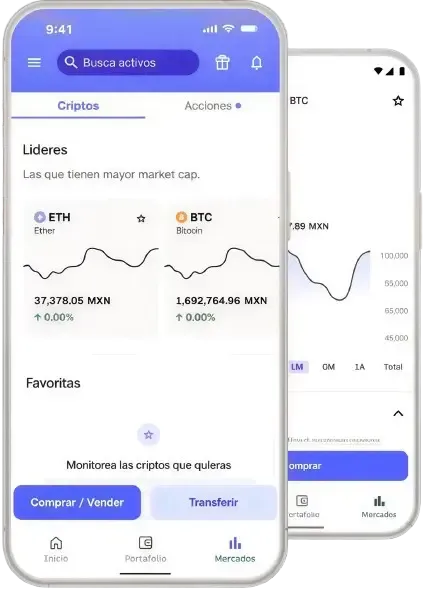
From the Bitso app you can make your first purchase from your phone through Nvierto by Bitso*.
What is Amazon stock and why is it so popular?
Amazon shares represent a proportional part of the ownership of Amazon.com Inc., the Seattle-based company that trades on the NASDAQ under the ticker AMZN, the identifier that brokers and investment platforms use to refer to it.
Amazon is not just e-commerce. Its business combines e-commerce, cloud computing through Amazon Web Services (AWS), digital advertising and artificial intelligence. That diversification is one of the reasons AMZN is closely followed in the markets: the company does not depend on a single revenue line, and each segment responds to different economic cycles.
With a market capitalization of more than 2 trillion dollars, Amazon is among the most valuable companies listed on a stock exchange.
Amazon’s business model: why AWS moves the AMZN price
Understanding what actually generates Amazon’s profits helps you read the news about AMZN better. Not all of the company’s businesses weigh the same in the final result.
E-commerce: Amazon’s main business
Amazon’s original business (marketplace, Prime, last-mile logistics) is still the one that generates the most total revenue. E-commerce, that is, buying and selling products over the internet, requires a lot of infrastructure: distribution centers, transportation, inventory. That is why it leaves tighter profit margins than other parts of the business.
AWS: Amazon Web Services and Amazon’s cloud computing
Amazon Web Services (AWS) is the company’s cloud computing arm: it rents computing capacity, storage and artificial intelligence services to other companies, instead of each one building its own server infrastructure.
Artificial intelligence and advertising: Amazon’s new growth engines
Amazon competes in artificial intelligence infrastructure through AWS and has directed heavy investment toward data centers and its own chips for that purpose. In parallel, its digital advertising business (ads inside the marketplace and on its streaming platforms) has become a high-margin source of revenue, separate from the physical sale of products. These are the two lines the market checks first when the price moves without a shopping season in between.
How much does an Amazon share cost today?
To check the real-time quote for AMZN you can use the Bitso app, where you will see the updated price before confirming your trade through Nvierto by Bitso*.
A useful fact for anyone who remembers prices from other years: in June 2022, Amazon did a 20-for-1 split. Before the split, a share was trading around 2,800 dollars; afterward, the equivalent price dropped to about 140 dollars. A split does not change the total value of your investment or the real size of the company. It only spreads the same value across more shares, each one more affordable in price.
The good news for anyone starting with little capital: you do not need the full price of a share. With fractional shares, you can invest in Amazon with the amount you have available.
Does Amazon pay dividends?
Amazon does not pay dividends to its shareholders. The company reinvests its profits in AWS, in its logistics network and in artificial intelligence infrastructure, instead of distributing cash on a regular basis.
As an alternative way to return value, Amazon has repurchased its own shares, which reduces the number of shares outstanding. This is not the same as a dividend and does not guarantee an effect on the price.
Is it worth investing in Amazon stock?
There is no single answer: the price of any stock is subject to market fluctuations and no past return guarantees future results. That is why, before making a decision, the first step is to define an investment strategy aligned with your time horizon, your budget and your risk tolerance. To assess whether Amazon fits in your portfolio, it helps to analyze the company from three key angles:
Fundamental analysis of Amazon stock: what the long-term investor looks at
Fundamental analysis evaluates the financial health of the business: market capitalization, revenue growth by segment (especially AWS), operating margins and level of investment in infrastructure. In Amazon’s case, the combination of e-commerce, cloud, advertising and AI is usually analyzed as a form of diversification within a single company.
Technical analysis of AMZN: how the active investor reads the price
Technical analysis, on the other hand, studies AMZN’s price and volume charts to identify trends and possible entry or exit points. It is an approach used more by those who trade over short or medium time frames, not by those who want to hold a position for years.
Opportunities and risks of investing in Amazon stock
Among the opportunities usually mentioned for AMZN are AWS’s leadership in cloud computing, the expansion of artificial intelligence services and the growth of the advertising business. Among the risks are regulatory scrutiny on competition issues, direct competition from other cloud providers such as Microsoft Azure and Google Cloud, and the general volatility of the stock market. For those who prefer not to concentrate their investment in a single company, a technology-sector ETF is an alternative that groups several companies, Amazon among them, and offers automatic diversification in a single instrument.
That a trade can be completed in a few steps does not change the risk of the asset.
Fractional Amazon shares: invest with what you have
A fractional share is, literally, a portion of a share: instead of paying the full price of one AMZN share, you buy the fraction that matches the amount you want to invest through Nvierto by Bitso*.
This matters especially in Amazon’s case: even after the 2022 split, the price of a whole share can still be out of reach for someone starting with little capital. With a fraction, you own a proportional part of that share and take part in the same performance, scaled to your investment.
How to buy Amazon stock in Mexico with Bitso
You do not need to open an account with a broker abroad to invest in Amazon from Mexico. You can access the services offered by Nvierto by Bitso* to buy shares or fractions of shares by sending your instruction to Alpaca Securities LLC, the US broker-dealer that executes and holds the trade in custody.
- Open your account: a digital process from the Bitso app.
- Deposit: through SPEI.
- Search for Amazon (AMZN): check its price and performance inside the app before deciding.
- Choose the amount and confirm your instruction: Nvierto by Bitso* receives and sends your instruction to Alpaca Securities LLC, which executes the trade and holds the fraction of the share in custody in your name.
If your purchase is made in Mexican pesos, the final price you see already includes the applicable currency conversion: it is not a transaction without any associated cost.
Your money is capable of gaining access to companies like Amazon, without leaving the app you already use every day.
Amazon stock compared with other tech stocks
Comparing Amazon with other technology companies helps put its size and the way it distributes (or does not distribute) profits in context. These names are presented only as comparative examples from the sector; they are not investment recommendations.
| Company (ticker) | Sector | Pays dividends? |
|---|---|---|
| Amazon (AMZN) | E-commerce + cloud computing | No |
| Microsoft (MSFT) | Software + cloud | Yes, quarterly |
| Alphabet (GOOGL) | Advertising + services | Yes (recent) |
| NVIDIA (NVDA) | Semiconductors / AI | Yes, symbolic |
Investing in Amazon stock gives access to the growth of one of the most diversified companies in the world, with a business that combines e-commerce, cloud, advertising and artificial intelligence. Knowing its price, understanding why it does not pay dividends and how a fractional share works turns the decision into an informed step.
Discover what your money is capable of through the services offered by Nvierto by Bitso*.
Frequently asked questions about how to buy Amazon stock
The price of AMZN changes in real time with the market. Check the current quote on sources such as Yahoo Finance or Google Finance, or inside the Bitso app, before deciding how much to invest.
No. Amazon reinvests its profits in AWS, logistics and artificial intelligence instead of paying dividends. As an alternative, it has repurchased its own shares in different periods.
In June 2022, Amazon split each share into 20. The price per share dropped proportionally, but the total value of any existing investment did not change: a split spreads the same value across more shares.
Amazon Web Services (AWS) is Amazon's cloud computing business. According to the fourth-quarter 2025 earnings report, published in February 2026, it contributed about half of the company's operating income. That is why its results tend to influence the AMZN price more than its share of sales would suggest.
Yes. When you confirm your trade in pesos, you see the final price already including the currency conversion through Nvierto by Bitso*.
They are portions of a whole share. They let you invest with the amount you have available, without paying the full price of an Amazon share, and take part proportionally in its performance.
A CFD (contract for difference) is a derivative product that tracks the price movement of an asset, but the person trading does not own that asset. Through Nvierto by Bitso* you buy real shares or fractions of Amazon shares, not a derivative.
Amazon was founded in 1994 by Jeff Bezos, originally as an online bookstore. Over time it expanded its business into general e-commerce, cloud computing, advertising and artificial intelligence.
Besides its marketplace and AWS, Amazon operates Amazon Prime Video, the Whole Foods supermarket chain (acquired in 2017) and its own digital advertising network, among other businesses.
In part. Amazon competes with eBay and Alibaba in e-commerce, and with Netflix in video streaming through Prime Video, although streaming is not its main source of revenue. Its most relevant competition for the stock price is in the cloud, against Microsoft Azure and Google Cloud.
Legal notices
* The Nvierto by Bitso brand identifies the services provided by Nvierto, S.A. de C.V., Asesor en Inversiones Independiente (Independent Investment Advisor), registered in the Investment Advisors Registry of the Comisión Nacional Bancaria y de Valores (National Banking and Securities Commission) under folio 30205.
The Bitso app works only as the digital channel through which users can learn about, contract and access the services provided by Nvierto, S.A. de C.V., Asesor en Inversiones Independiente. Bitso does not provide the investment advisory or trade execution services described in this article.
Trade execution and custody of foreign securities are carried out by Alpaca Securities LLC, a broker-dealer registered with the US Securities and Exchange Commission and a member of FINRA and SIPC. Alpaca Securities LLC executes and holds the securities according to the instructions sent by Nvierto, S.A. de C.V., Asesor en Inversiones Independiente.
The information provided is for informational purposes only and does not constitute financial or legal advice. It is not a personalized recommendation to buy or sell securities. All investing involves risk, including the possible partial or total loss of capital. Past returns do not guarantee future returns. Keep in mind that the market for stocks, ETFs and equities can be highly volatile and that an increase in the market value of your assets is not guaranteed. Seek professional advice and do your own research before making investment decisions.
The images and logos shown are used for illustrative purposes only, and do not constitute a personalized recommendation, or an offer or promotion to buy or sell specific securities.